

How UNIVO School of AI, an AI certification school, got a course website its own team can run
UNIVO School of AI teaches live, faculty-led AI courses. On its old site, every fee, date and faculty change needed a developer. Filari audited the live server, planned a rebuild beside it, and moved the site onto Next.js and Strapi, with 73 of 73 checks passed.
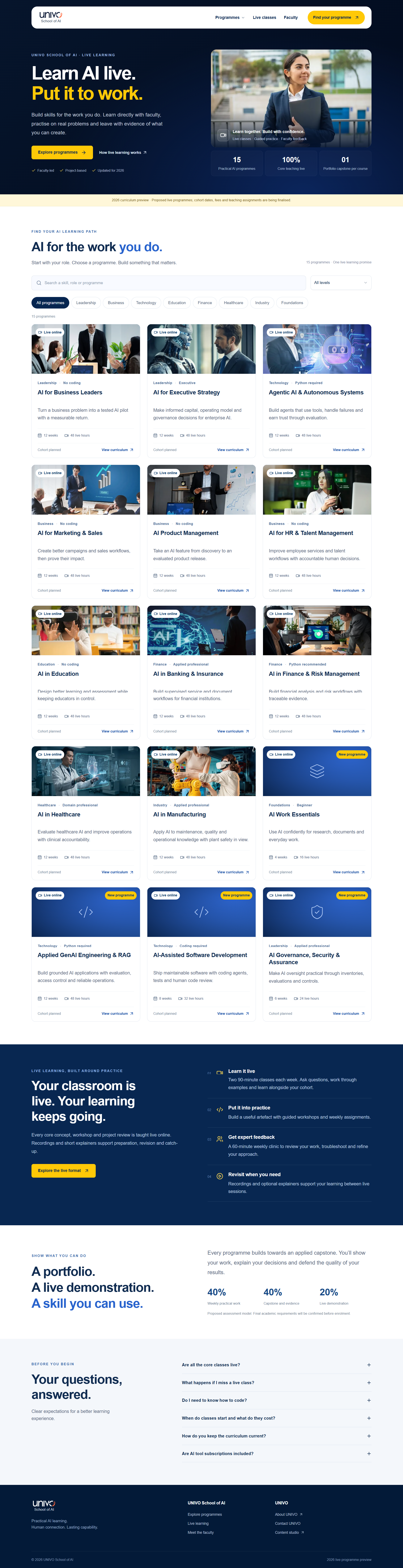
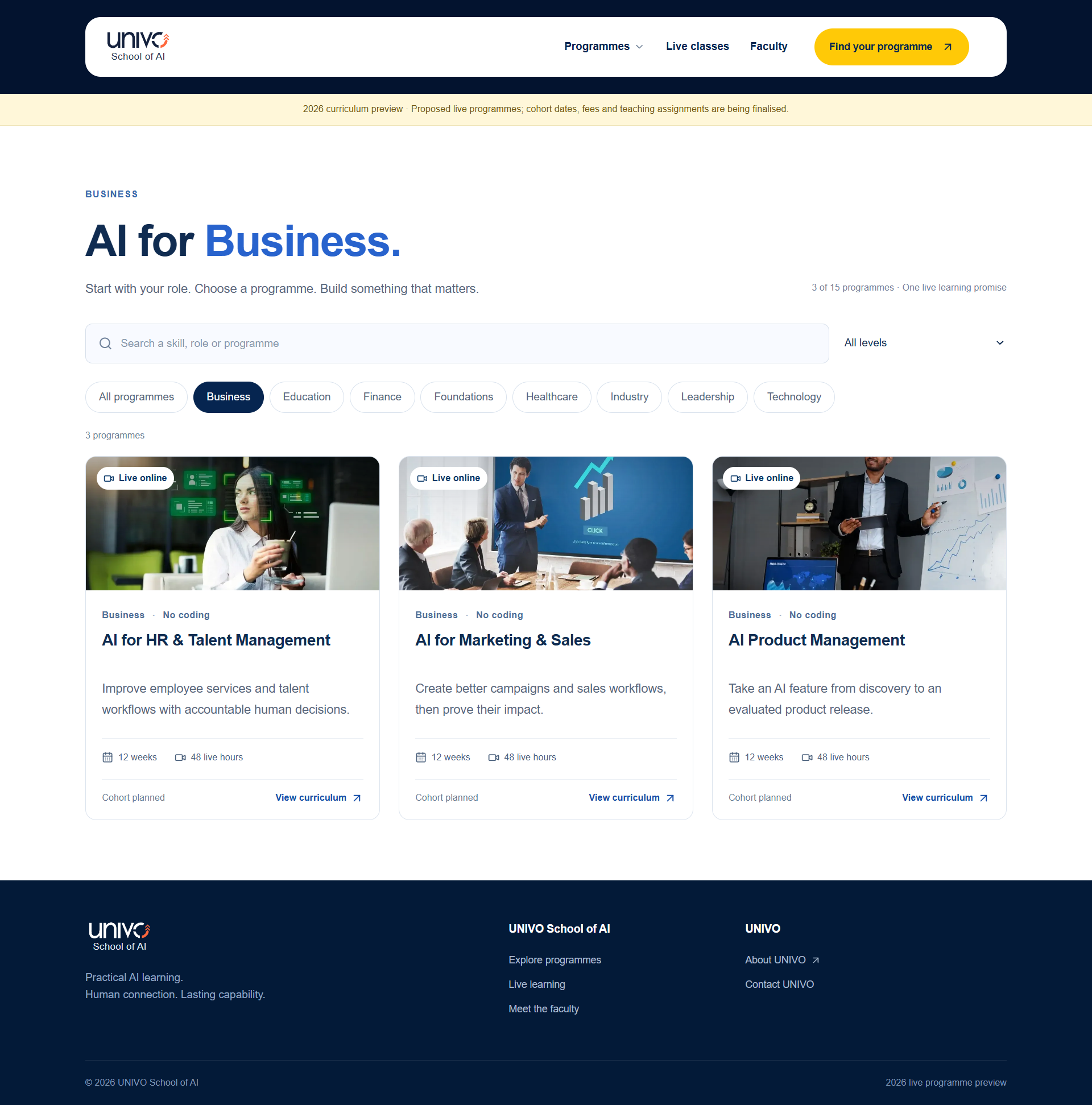
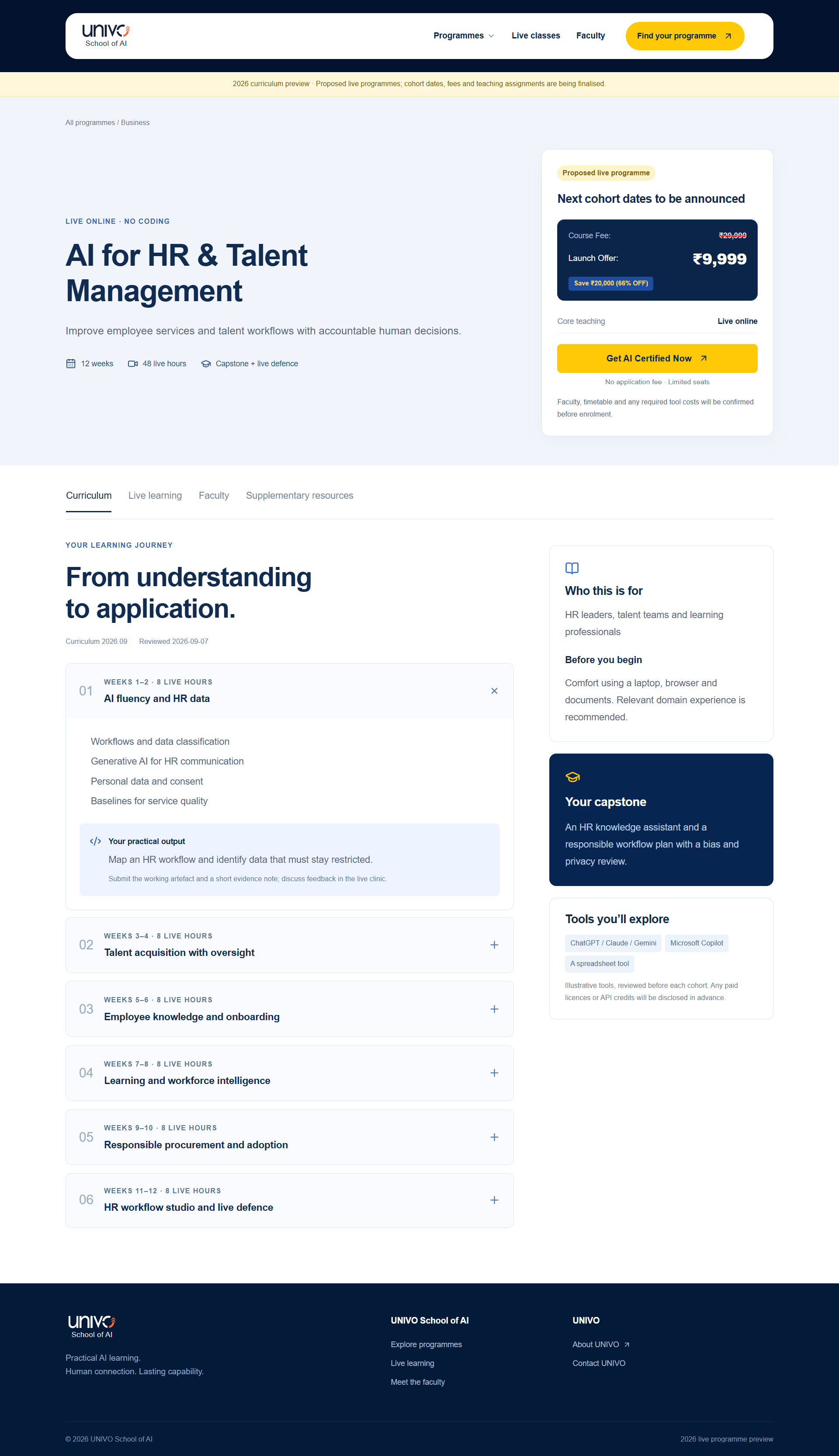
Every change needed a developer
Every fee, date and faculty change lived inside the code, on a Cloudflare-only stack UNIVO's own server could not run.
A rebuild beside the live site
A rebuild on Next.js 16, Strapi 5, MySQL 8 and S3, beside the live site, with all 15 courses moved across.
A site the team runs itself
73 of 73 checks passed, pages respond in 66–115 ms, and the team edits every course from an admin panel.
Add an .mp4 path or YouTube link to data-video on the hero.
A Next.js Strapi website for a school that teaches AI
UNIVO School of AI runs live, faculty-led AI certification courses. Its website kept all course content in a code file and ran on a Cloudflare Workers stack, so every change needed a developer. Filari rebuilt it as a Next.js 16 site with a Strapi 5 CMS, MySQL 8 database and S3 media, migrated 15 courses, 83 modules and 10 faculty profiles, and passed 73 of 73 UAT, security and accessibility checks without touching the live site.
Key takeaways
- 01Filari rebuilt UNIVO School of AI's website on Next.js 16.1.6, Strapi 5.39, MySQL 8 and Amazon S3, to the client's exact version list.
- 0215 courses, 83 modules and 10 faculty profiles moved from a code file into a CMS the UNIVO team edits without a developer.
- 03The new build passed 73 of 73 checks: 35 UAT, 13 security and 25 accessibility.
- 04Pages respond in 66–115 ms, and all 22 media files are WebP on S3.
- 05The rebuild ran in a separate folder on the same server, and the live site's restart count stayed unchanged throughout.
Project snapshot
A course website rebuild with a CMS the school runs itself
- Client
- UNIVO School of AI, part of UNIVO Education
- Industry
- Education: live AI certification courses
- Project type
- Website rebuild with a headless CMS
- Filari's role
- Audit, rebuild, migration, Salesforce leads, testing, handover
- Technology
- Next.js 16, Strapi 5, MySQL 8, Amazon S3, Salesforce
- Timeline
- Confirm
Our approach
- 01AuditRead the live server, read-only
- 02PlanRebuild instead of migrate
- 03Protect liveBackup, swap, rules, separate folder
- 04Rebuild15 courses, 83 modules, 10 faculty into Strapi
- 05IntegrateOTP check and Salesforce leads
- 06Test73 UAT, security and accessibility checks
- 07Hand overPlain-English docs, 204 tracked tasks
A course website that only a developer could change
UNIVO School of AI, part of UNIVO Education, offers AI certification courses taught through live classes with faculty, applied projects and a structured curriculum. Learners find a course on the website and enquire through a form that goes to the sales team.
The UNIVO team wanted to change a course fee. On the old site that meant a developer editing a code file and redeploying. The same was true for dates, faculty profiles, FAQs and every other piece of content.
All course, faculty and FAQ content sat in one code file.
The data lived on Cloudflare, not on UNIVO's own server, and images sat inside the project folder.
There was no student or faculty login.
What UNIVO wanted
- Edit every course, module, faculty profile and FAQ without a developer.
- Keep all data on UNIVO's own MySQL database and all media on S3 as WebP.
- Add student, faculty and admin logins.
- Build it all without disturbing the live site.
What the server audit found
Before writing any code, our team connected to the live server read-only and checked what was really running. The documents described a standard Next.js site. The server told a different story.
The live code imported modules that only work on Cloudflare. It could not be moved. It had to be rebuilt.From Filari's server audit, 10 September 2026
So the plan changed from a migration to a rebuild: a clean Next.js 16 project with the same design and the same content, on standard code that runs on UNIVO's own server.
Rule one: don't touch the live site
UNIVO asked for the new build on the same server, so learners would keep using the live site while we worked beside it. We set rules before the first line of code and checked them at the end.
The live folder is read-only. The live process is never restarted.
All new work lives in a separate folder, with its own processes, port and web route.
Nothing is hardcoded. Every URL, key and path comes from one config file.
No secret ever goes into git or the browser. Every image is WebP.
Before starting, the team backed up the live site, added swap memory, and installed MySQL 8 and Node 20 alongside the live Node 22. At handover, the live site still answered every page, and its restart count was the same 9 it had been on day one.
Rebuilding it the standard way
The new site runs on the exact versions UNIVO specified: Next.js 16.1.6, Strapi 5.39, Node 20, MySQL 8 and Amazon S3. Here is what the team and learners get.
A CMS the UNIVO team runs
Change a fee or date without a developerCourses, modules, faculty, live classes, resources, FAQs and site settings are all edited in the Strapi admin panel. Changes appear on the site within 60 seconds.
For: UNIVO content and admissions team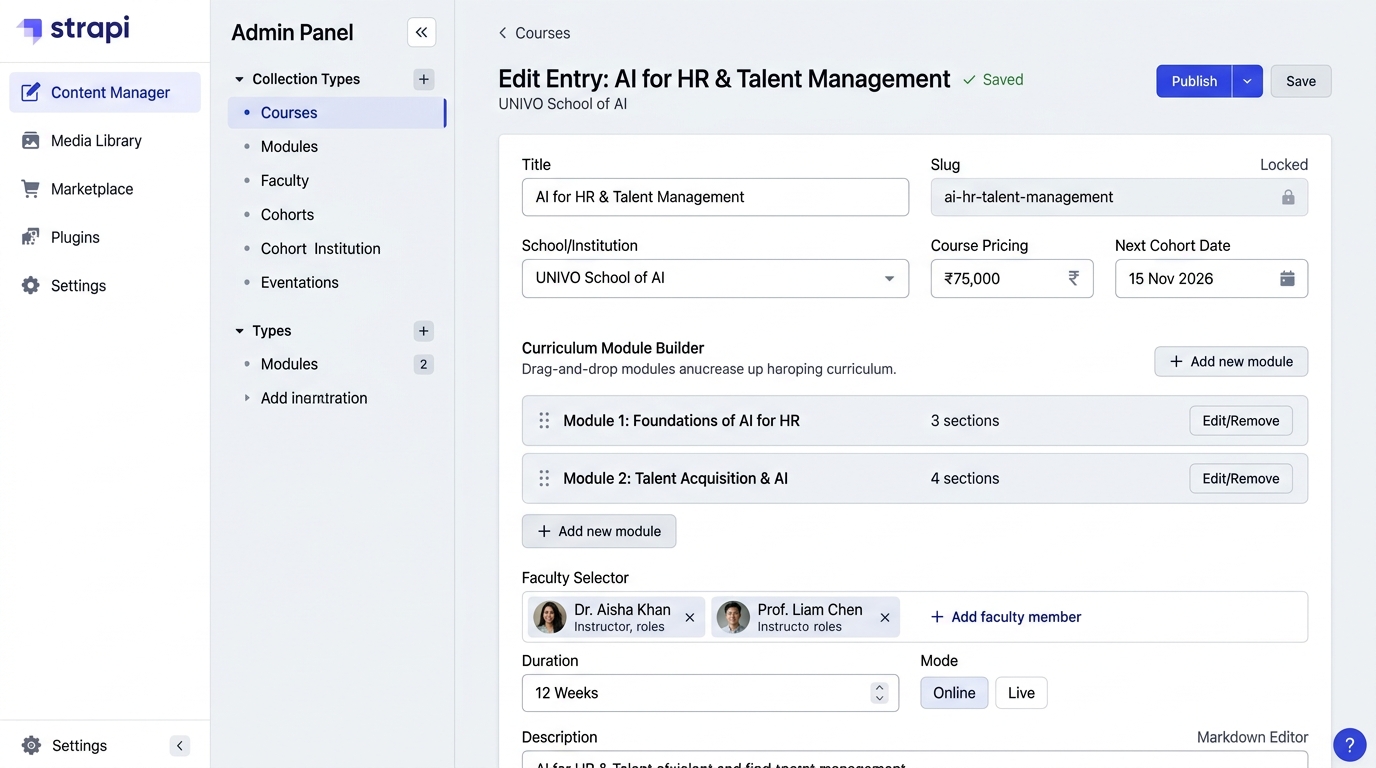
15 course pages, built ahead of time
Fast pages that search engines can readEach course page is generated at build time with its curriculum, fee card, faculty and FAQs, then refreshed from the CMS. Course pages respond in about 115 ms.
For: prospective learnersThree separate logins
Each person sees only what they needAdmins log in to the CMS, students log in with their mobile and a one-time code, and faculty log in with email and password to see their own classes.
For: admins, students, faculty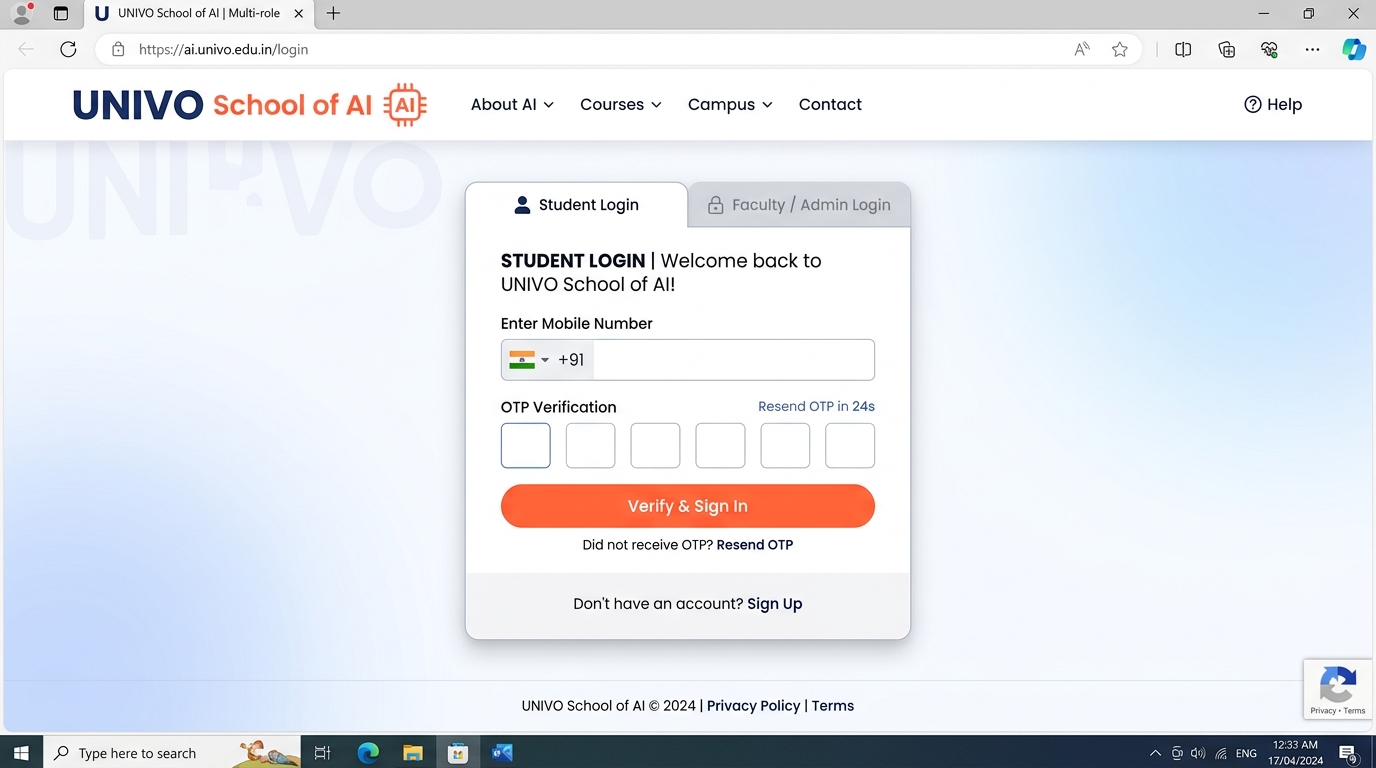
Media on S3, always WebP
Lighter pages, nothing stored on the serverEvery uploaded image is converted to WebP and stored in UNIVO's S3 bucket. In testing, a 9 KB JPG became a 3 KB WebP, 69% smaller.
For: everyone who loads the site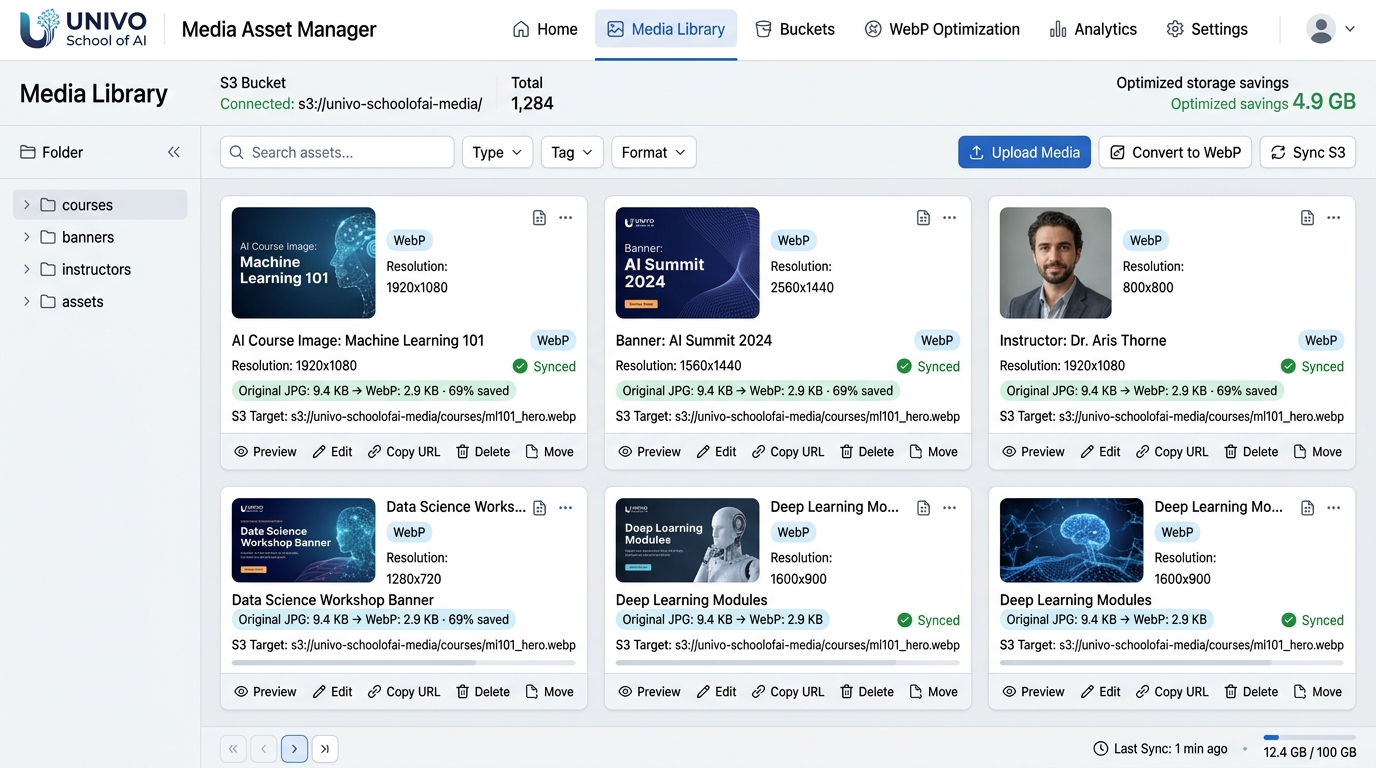
Settings in one place
Move or rebrand without hunting through codeNo URL, key, path or email address is written into the code. Everything comes from one configuration file, so changing it once changes it across the site.
For: UNIVO IT and future developersNEXT_PUBLIC_BASE_PATH=/schoolofai
STRAPI_URL=••••••
S3_BUCKET=••••••
OTP_TEST_BYPASS_ENABLED=falseWhat a learner sees on the new site
From enquiry to Salesforce, without losing a lead
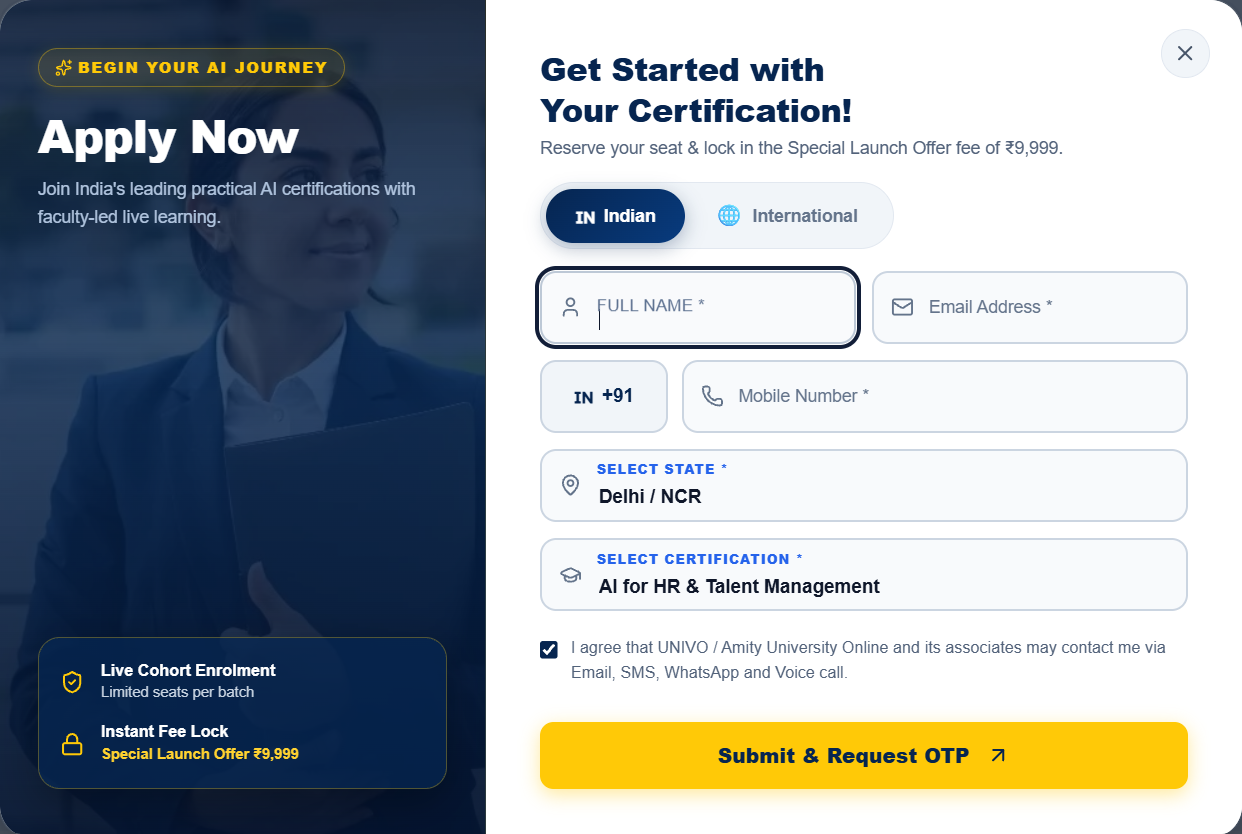
A learner presses Get AI Certified Now, enters their details and verifies their mobile with a one-time code. The number is checked in the browser and again on the server. The enquiry is saved first, then sent to Salesforce.
If Salesforce is down, the lead stays in the database marked as failed. No enquiry disappears.How the lead flow is designed
Found in our own review, then fixed
UNIVO asked that test numbers starting with 23 skip the OTP during UAT. Our security review found that the lead code checked for "starts with 23" but not for "are we in UAT". In production, a real learner whose number began with 23 would have seen a thank-you message while their lead never reached Salesforce. The check was fixed before handover, and the bypass is now switched off in production by three separate checks.
Proving it works, before anyone relied on it
UNIVO School of AI now has a course website its own team can update, running on its own server and storage, with enquiries flowing to Salesforce and a full record of how every part works.
Checks passed, by type
What else was verified
- Leads, students and enrolments return 403 without a token
- No API token or secret in the browser bundle
- Nightly database backup at 2 a.m.
- Live site pages all returned 200, restart count unchanged
Handing it over so nobody depends on one person
Every part of the system is written down in plain English: the audit, the architecture, each CMS field, every API, deployment steps, the security checks and the test plan. A project tracker followed 204 tasks, and a credentials handover moved every secret safely to UNIVO.
Where AI helped, and where people led
Tools to confirmHuman-led, AI-accelerated. Our team made every design and architecture decision and reviewed every change. The tools used will be listed once confirmed.
What we learned
Read the server before you quote a migration. UNIVO's documents described a standard Next.js site, but the server ran Cloudflare-only code. Checking first turned a migration that would have failed into a planned rebuild. For course websites, the content model matters more than the pages: once courses, modules and faculty are records in a CMS, the school can run its own site.
What's next: automatic retry for leads that fail to reach Salesforce, a shared rate limiter if the site scales to more than one process, and a planned upgrade window for Strapi and Next.js. Confirm
For tech teamsUnder the hood
Stack, architecture and engineering decisions
Stack by layer
Frontend
Next.js 16.1.6
Static course pages, 60-second refresh
SCSS + Tailwind
The live design ported exactly
CMS
Strapi 5.39 on Node 20
Programmes, faculty, sessions, resources, leads, students, enrolments
Custom OTP + lead APIs
Rate-limited, bypass off in production
Data & media
MySQL 8, localhost only
Nightly backup at 2 a.m.
Amazon S3, WebP
No media stored on the server
Architecture
The browser talks only to the Next.js server. Next.js renders pages and exposes small same-origin API routes for OTP and leads, which call Strapi on localhost. Strapi reads and writes MySQL, stores media on S3 and forwards verified leads to Salesforce.
Engineering decisions
| Decision | Why | Impact |
|---|---|---|
| Rebuild, not migrate | The live code imported Cloudflare-only modules that cannot run on Node | A clean, standard codebase UNIVO can host anywhere |
| Build beside live, not over it | The live site had to keep running | Live restart count unchanged through the project |
| Save the lead before calling Salesforce | A Salesforce outage must not lose an enquiry | Failed sends stay in the database, marked failed |
| Browser never calls the CMS directly | API tokens in a JS bundle are public | Zero secrets in the browser bundle |
| Nothing hardcoded | URLs and keys change between beta and live | One config file drives every environment |
| Audit the test-number bypass | Code that looks right can fail silently | Fixed a bug that would have hidden real leads |
Questions teams ask before a rebuild
The old UNIVO School of AI site ran Next.js on a Cloudflare Workers toolchain and imported modules that only work on Cloudflare. That code cannot run on a standard Node server, so Filari rebuilt it as a clean Next.js 16 project with the same design and content.
Yes. Courses, modules, faculty, live classes, resources, FAQs and site settings are all edited in the Strapi admin panel. Changes appear on the website within about 60 seconds, with no code change or deployment.
Filari built the new site in a separate folder on the same server, with its own processes, port and web route. The live folder was treated as read-only, and the live process's restart count was checked before and after to confirm it was never disturbed.
A learner enters their details and verifies their mobile with a one-time code. The enquiry is saved in the database first, then sent to Salesforce, and the result is recorded. If Salesforce is down, the lead stays in the database marked as failed.
Filari ran 73 checks on the new build: 35 UAT tests covering versions, data, media, OTP and pages, 13 security checks and 25 accessibility checks. All 73 passed, and the live site was confirmed unaffected.
Strapi gives non-technical staff an admin panel for structured content like courses and modules, and MySQL keeps that data on the client's own server. Together they replace content that was previously hardcoded in a file.
Is your website's content stuck in the code?
Tell us what you run today. We will audit it, and show you what a CMS your team controls looks like.
More projects like this one

 Education
Drupal to Next.js in 48 Hours: Executive Education Platform
Rebuilding Amity Executive Education's programme finder, compare tool, counselling leads and payment gateway on Next.js 15.
 Education
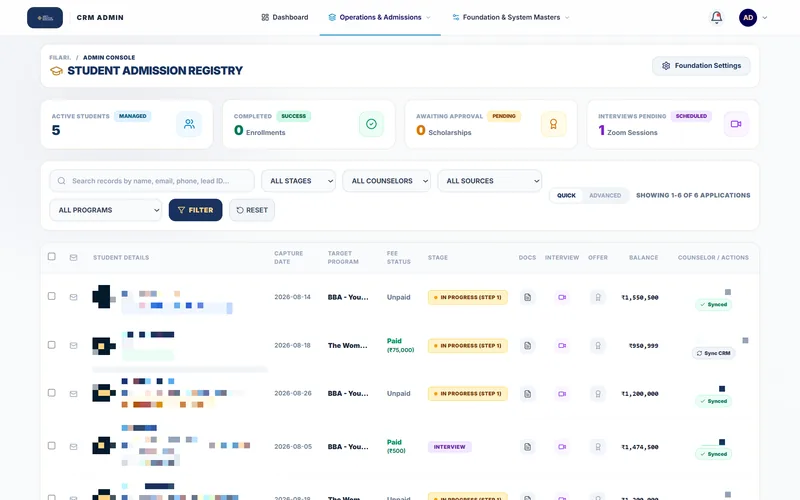
Admission Management Platform for Executive Education
One platform for every admission: no-code application forms, interviews, scholarships, offer letters, online fees and LeadSquared sync.
 Corporate Learning
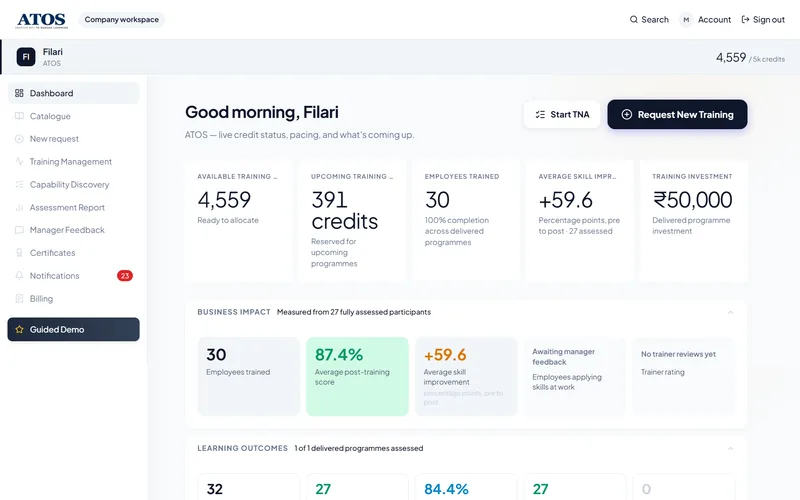
From Prototype to Live Corporate Training Platform
Filari built the backend, security, GST billing and reporting behind Amity's training-credit prototype and put it live, keeping the approved design.